
There is something that has always fascinated me whenever I read philosophy, spirituality, religion, psychology, or esoteric literature. Although the authors speak different languages and come from different cultures, I have often noticed that many of them seem to be pointing toward the same underlying truth.
A Buddhist, a Christian mystic, Gurdjieff, an existential philosopher, or a shaman may offer completely different explanations of reality. Yet when you read between the lines and set aside the unique concepts of each tradition, a common theme begins to emerge.
They all appear to be asking the same question:
What does it mean to be alive in the face of the unknown?
Birth and Death: The Two Shores of Existence
Each of us enters this world without knowing where we came from.
We spend a few decades living, loving, suffering, dreaming, building, destroying, and searching for answers.
And then we leave.
Just as we have no memory of what existed before our birth, we cannot know with certainty what exists beyond death.
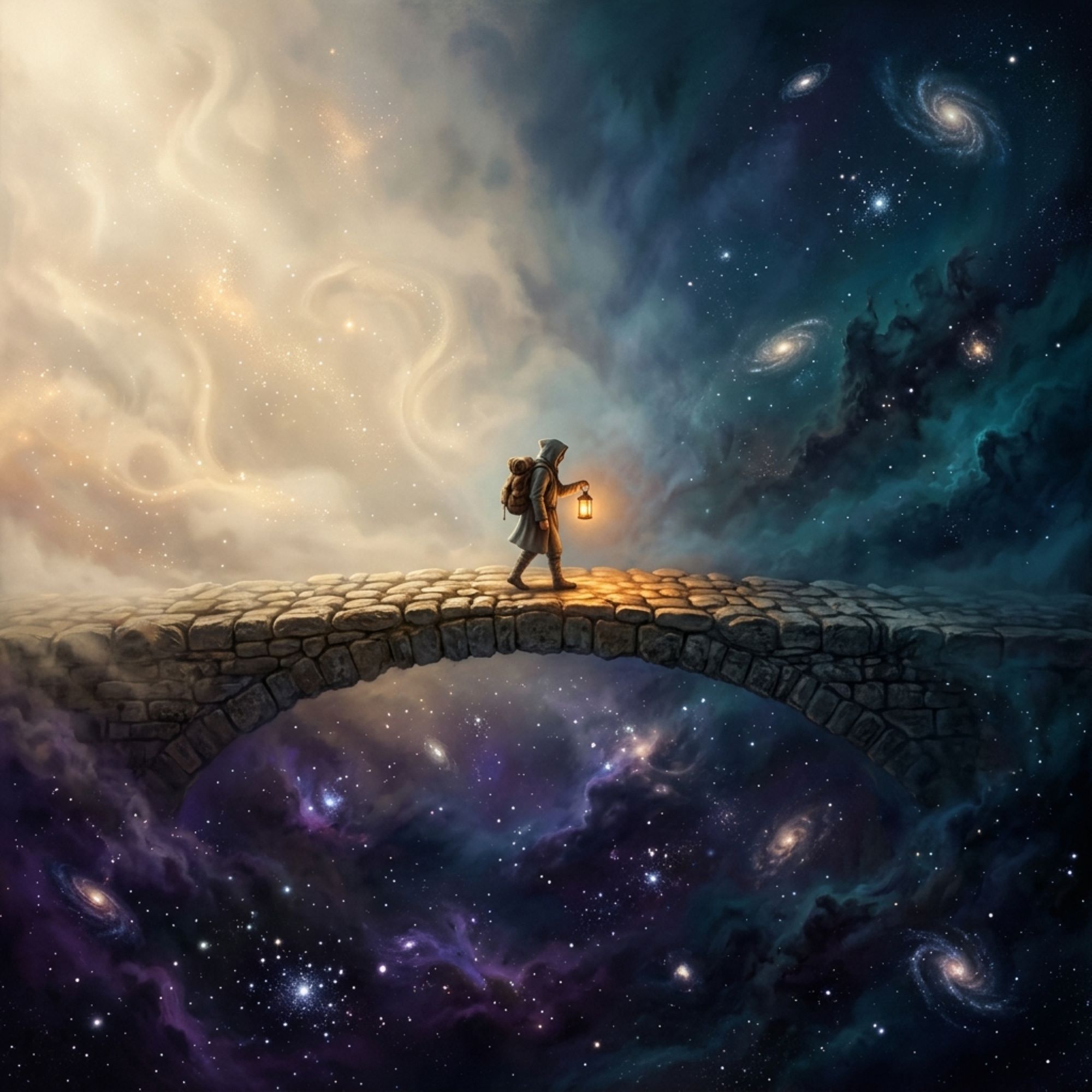
We are, therefore, beings who live between two mysteries.
Perhaps one of the most profound human experiences is the realization that we exist temporarily between two unknowns we may never fully understand.
Why Do We Need Stories?
Faced with this mystery, humanity has always created stories.
Not in a negative sense.
Stories help us understand the world, soothe our fears, and give form to questions that might otherwise feel impossible to bear.
This is how we developed:
- religions;
- myths;
- philosophical systems;
- theories about the afterlife;
- spiritual practices;
- cosmologies and worldviews.
Every culture and every era has drawn its own map of the mystery.
Some speak of reincarnation.
Others of heaven.
Others of enlightenment.
Others of the void.
Perhaps none of these visions can ever be proven conclusively. Yet they all attempt to answer the same fundamental unease.
The Search for Meaning
Many people spend their entire lives asking about the meaning of existence.
We often imagine that somewhere, beyond the final turn in the road, there is a definitive answer waiting for us.
A formula.
A revelation.
A conclusion that will bring all questions to an end.
But what if meaning is not a destination?
What if meaning is not something we find at the end of the journey, but something we create along the way?
If that is true, everything changes.
Instead of waiting for the perfect answer, we begin to pay attention to how we live each day.
Meaning is no longer a distant treasure.
It becomes a relationship with existence itself.
The Great Encounter with the Unknown
There are moments in life when our ordinary sense of identity begins to dissolve.
During sleep.
In dreams.
In meditation.
In mystical experiences.
In times of crisis.
In moments of loss or deep transformation.
At such times, we discover something remarkable: the world we once considered solid may be far less certain than we imagined.
Our certainties begin to fade.
And beyond them, the unknown appears.
Some call it God.
Others call it the Absolute.
Others call it Consciousness.
And some prefer not to give it any name at all.
Perhaps all of these words are simply different attempts to describe the same experience, one that ultimately exceeds the limits of language.
The Mystic and the Skeptic
Mystics and skeptics are often portrayed as opposites.
Yet perhaps they are not as different as they seem.
Both eventually arrive at the edge of the same mystery.
Both gaze into what can never be fully known.
The difference lies in their response.
The mystic says:
“There is something beyond.”
The skeptic says:
“I do not know whether there is anything beyond.”
Yet both acknowledge the existence of the mystery.
Perhaps wisdom begins not with having answers, but with having the courage to remain in the presence of the questions.
Perhaps All Paths Lead Toward the Same Insight
After years of reading, I began to suspect that the world’s great traditions are not necessarily trying to tell us different things.
Perhaps they are describing the same mountain from different sides.
Some emphasize love.
Others emphasize knowledge.
Others emphasize compassion.
Others emphasize clarity and insight.
Yet all of them seem to point toward a transformation in how we relate to ourselves and to the mystery of existence.
Perhaps the real question is not who is right.
Perhaps the question is:
What are all of these traditions trying to show us?
A Conclusion Without a Conclusion
Perhaps we will never know what existed before our birth or what awaits us after death.
Perhaps some mysteries are not meant to be solved.
Perhaps their purpose is to keep us curious, humble, and fully alive.
And perhaps that is the most beautiful paradox of all.
We spend years searching for the meaning of life as though it were hidden at the end of the road.
But perhaps meaning is not concealed within the destination.
Perhaps it exists within the act of walking itself.
In asking.
In exploring.
In contemplating.
In loving.
In creating.
In standing in awe before the mystery from which we came and the mystery toward which we are headed.
And between those two unknowns, for a brief moment in eternity, we are given the extraordinary privilege of being here.
Leave a Reply